EV Battery Cathode Chemistry: What Operators Need to Know
A practical guide to chemistry groups, NMC ratios, VIN-based identification, recycling value, and better battery quotes.

EV battery cathode chemistry describes the active material on the positive electrode of a battery cell. In lithium-ion EV batteries, common cathode families include NMC, NCA, LFP, LMO, and blends of more than one material. The chemistry group comes first. Lithium-ion, nickel-metal hydride, and lead-acid are different battery groups. NMC and LFP are more specific cathode chemistries within the lithium-ion group.
For a recycler, dismantler, core buyer, or battery lifecycle operator, the cathode chemistry affects value, sorting, and processing. A VIN can often identify the battery configuration, but the VIN does not spell out the cathode chemistry by itself.
Need to confirm chemistry before you quote?
Use Explorer to connect a VIN or vehicle to battery records, chemistry, specifications, images, and possible battery options.
Start with the chemistry group
I think about battery chemistry in two layers. First, identify the group. Then get specific about the cathode.
The first layer matters because lithium-ion, nickel-metal hydride, and lead-acid batteries do not share one handling path or one recycling market. Calling a battery "NMC" skips the group because NMC is already a lithium-ion cathode family. Calling it only "lithium-ion" stops too early for many commercial decisions.
| Chemistry group | Cathode or positive-electrode examples | Where it shows up | What the operator needs to know |
|---|---|---|---|
| Lithium-ion | NMC, NCA, LFP, LMO, and NMC-LMO blends | Battery-electric vehicles, plug-in hybrids, and some hybrids | Exact cathode family, pack identity, condition, weight, route, and current buyer terms |
| Nickel-metal hydride (NiMH) | Nickel hydroxide / nickel oxyhydroxide: Ni(OH)2 / NiOOH, with NiO(OH) also used | Mostly hybrid vehicles in automotive traction use, including many Toyota, Ford, Honda, and GM hybrids | Vehicle application, condition, pack weight, and buyer acceptance |
| Lead-acid | Lead dioxide, PbO2 | Mostly low-voltage automotive batteries, plus a small number of early hybrid traction systems | Battery type, condition, weight, and the established lead-battery route |
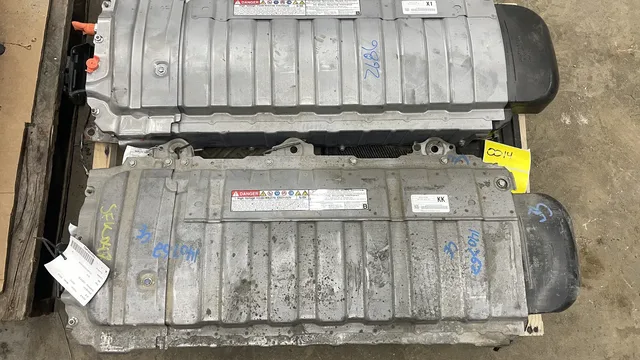
Believe it or not, the 2004 Chevrolet Silverado Hybrid used a lead-acid hybrid battery. In lead-acid chemistry, the positive electrode is lead dioxide, written PbO2.
NiMH is not an outlier. It became common in hybrid vehicles. An Argonne National Laboratory battery-technology report describes the positive electrode as nickel oxyhydroxide in the charged state and writes it as NiOOH. During discharge, it changes to nickel hydroxide, Ni(OH)2. ARC records may also use NiO(OH), which is another way to write NiOOH.
This article focuses on lithium-ion traction batteries, where the cathode family often changes the recovery and buying discussion. The group also changes the starting point for handling and transport, although chemistry alone is not a shipping decision.
What is a battery cathode?
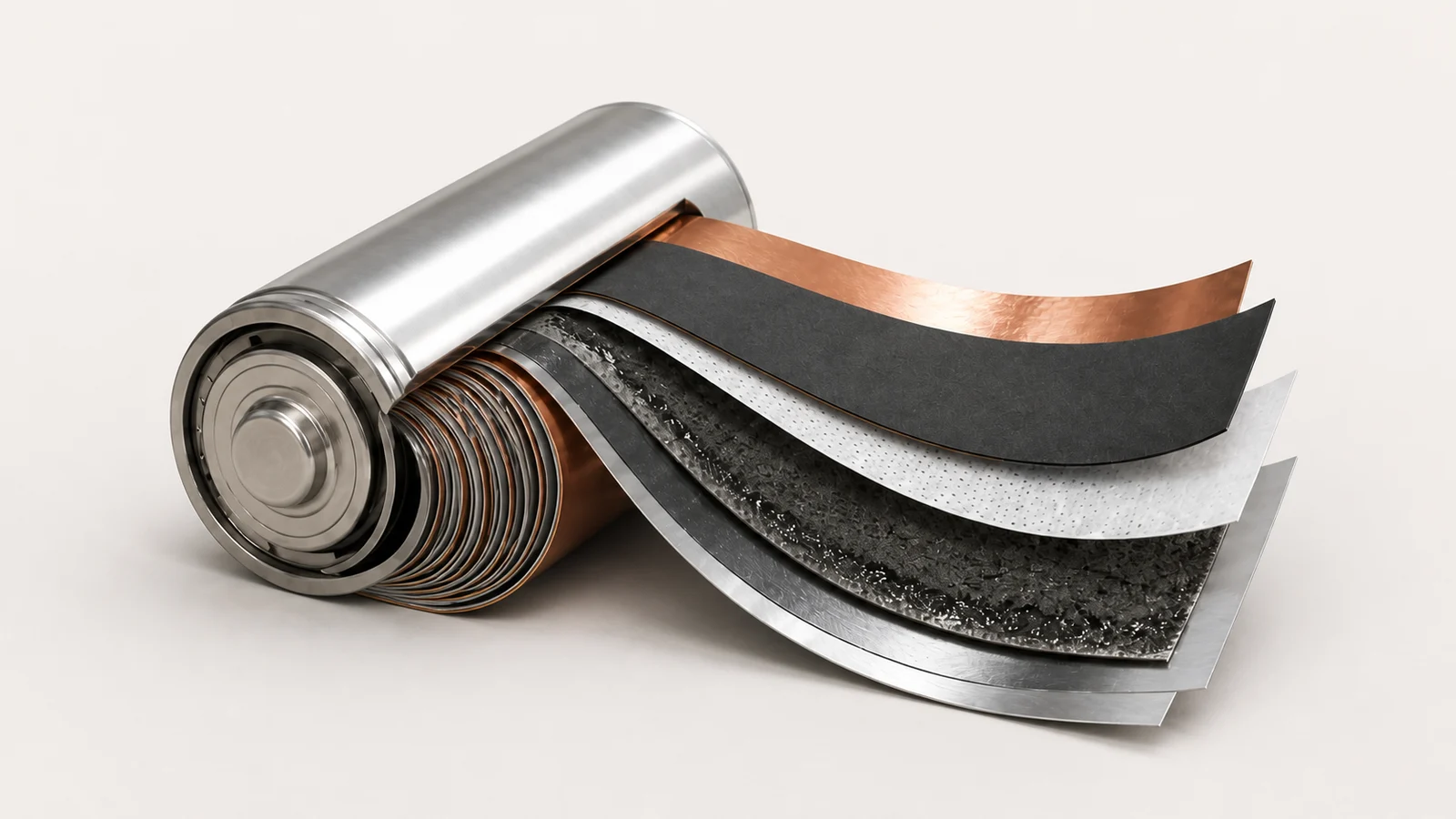
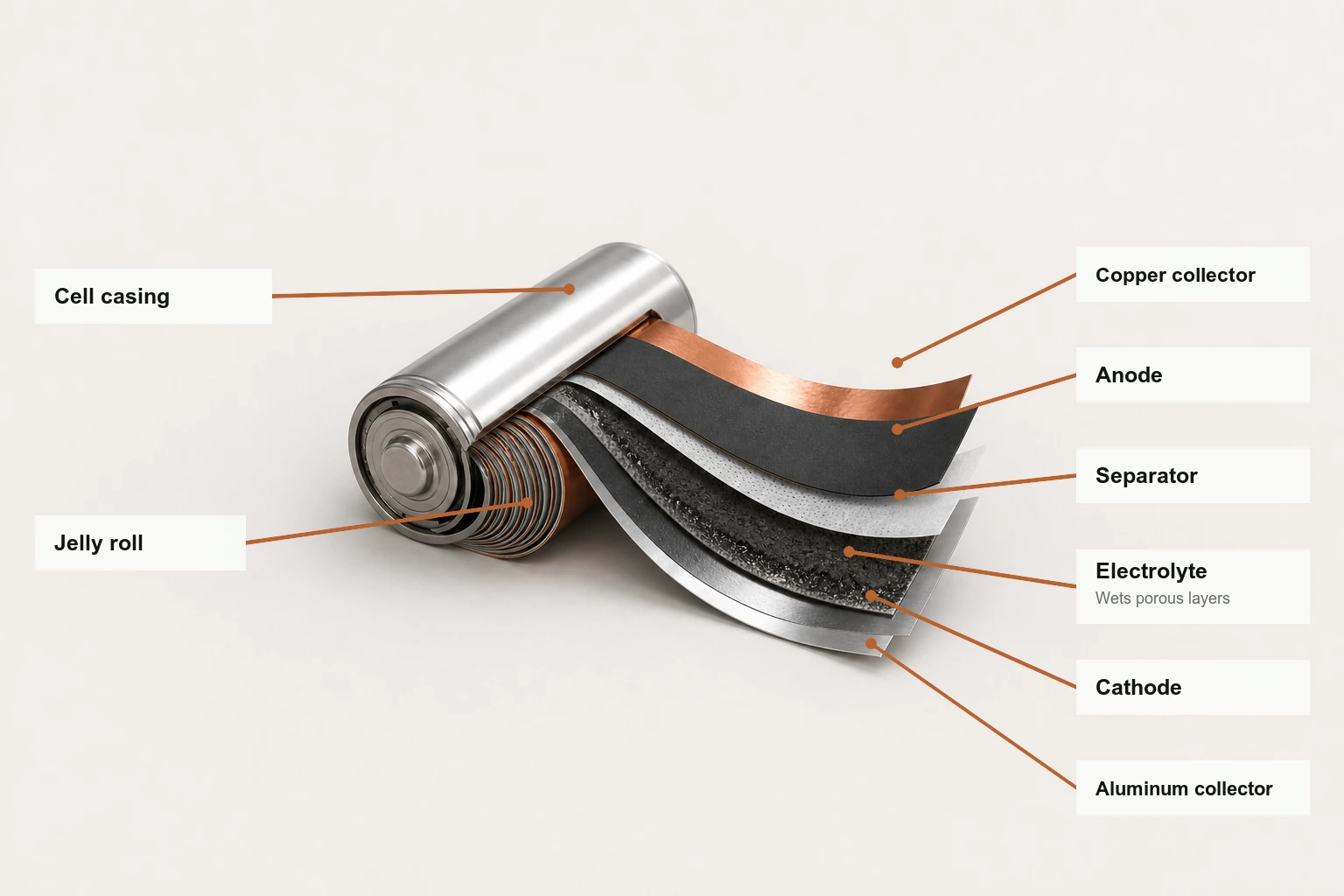
A lithium-ion cell contains an anode layer, a cathode layer, a separator, and an electrolyte. Copper and aluminum current collectors carry electrons into and out of the electrodes. The separator helps keep the electrodes from making direct electrical contact while still allowing ions to move through the electrolyte. The EPA's lithium-ion battery overview describes the same basic cell structure.
In normal battery-industry shorthand, the cathode is the positive electrode and the anode is the negative electrode. During charging, lithium ions move toward and are stored in the anode. During discharge, they move back toward the cathode. Most EV lithium-ion anodes use graphite or another form of carbon, although other anode materials exist. The Department of Energy's lithium-ion technology assessment lists graphite as the predominant anode material and identifies NMC, NCA, LFP, LMO, and LCO as major cathode classes.
Why do I spend more time on the cathode? It is where much of the metal mix that drives lithium-ion battery performance and recovery economics is concentrated. Nickel, cobalt, manganese, iron, phosphate, aluminum, and lithium may be part of the cathode discussion, depending on the chemistry. The anode and the rest of the pack still matter. Copper, aluminum, graphite, steel, electronics, and pack hardware are not worthless. But the cathode is often the first chemistry field that changes the bid.
What NMC 111, 622, and 811 mean
NMC stands for nickel, manganese, and cobalt. You may also see NCM. Both labels describe the same three transition metals, but the order of the letters follows the convention used by the source.
The numbers describe the approximate molar share of nickel, manganese, and cobalt in that part of the cathode material.
| Common name | Nickel | Manganese | Cobalt | Plain-language reading |
|---|---|---|---|---|
| NMC 111 | About 33% | About 33% | About 33% | Roughly equal shares |
| NMC 622 | About 60% | About 20% | About 20% | Six parts nickel, two manganese, two cobalt |
| NMC 811 | About 80% | About 10% | About 10% | Eight parts nickel, one manganese, one cobalt |
Peer-reviewed cathode research writes these as LiNi1/3Mn1/3Co1/3O2 for NMC 111, LiNi0.6Mn0.2Co0.2O2 for NMC 622, and LiNi0.8Mn0.1Co0.1O2 for NMC 811. See the Royal Society of Chemistry review of metal substitutions in lithium-battery cathodes.
Two things matter in the record:
- NMC 111 is the common equal-parts label, although some sources use NMC 333.
- Keep conventional labels such as 622 and 811 in the record. Do not simplify 622 to 311 as if it were a fraction. The conventional form communicates the expected composition to buyers, processors, and technical teams.
The name is still not an assay. It describes a nominal material family. It does not prove the exact composition, usable mass, contamination, recovery yield, or settlement value of a pack in front of you.
Why cathode chemistry matters before a quote
Cathode chemistry changes what valuable material may be present and how a processor can recover it. The EPA notes that battery chemistries differ in their material mix and that black mass can contain nickel, cobalt, lithium, manganese, graphite, and other materials in varying amounts. The International Energy Agency's critical-mineral recycling analysis also finds that the growth of LFP changes recycling economics because LFP has lower material value than nickel-based chemistries.
That does not mean every NMC pack has a positive quote or every LFP pack has a negative one.
A nickel-bearing pack may support a payment from one buyer and still lose its margin after freight, damage handling, or processing deductions. An LFP pack may have a positive route, a toll-processing route, a reuse option, or a service fee. In some current transactions, the owner may pay to move and process low-recovery-value material. In others, scale, location, condition, buyer demand, or a different process changes the offer.
My rule is simple: chemistry informs the quote. It does not replace current buyer terms.
For a complete valuation workflow, use ARC's guide to estimating EV battery scrap value by VIN.
Can a VIN identify an EV battery's chemistry?
The VIN by itself does not name a universal battery part number or cathode chemistry. It gives you the vehicle identity needed to make the connection.
ARC's Explorer makes that connection. Enter the full VIN and Explorer ties the vehicle configuration to ARC's battery records. In most cases, it returns the specific battery configuration the vehicle was built with.
When the VIN cannot separate every factory battery option, Explorer does not send you back to a blank search. It often whittles the list down to one or two likely packs. Then it shows you the labels, part numbers, specifications, and pack images that can close the gap. You are no longer researching every battery ever used in that model. You are checking the small set of candidates ARC has already isolated.
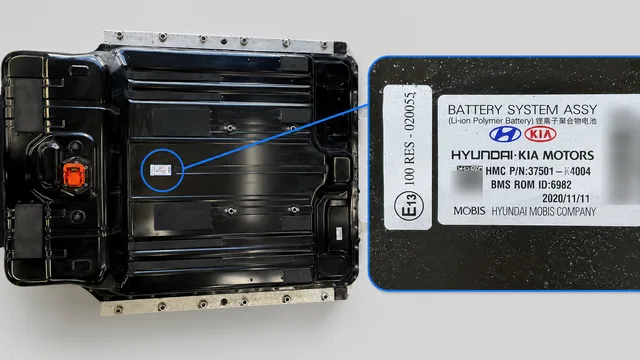
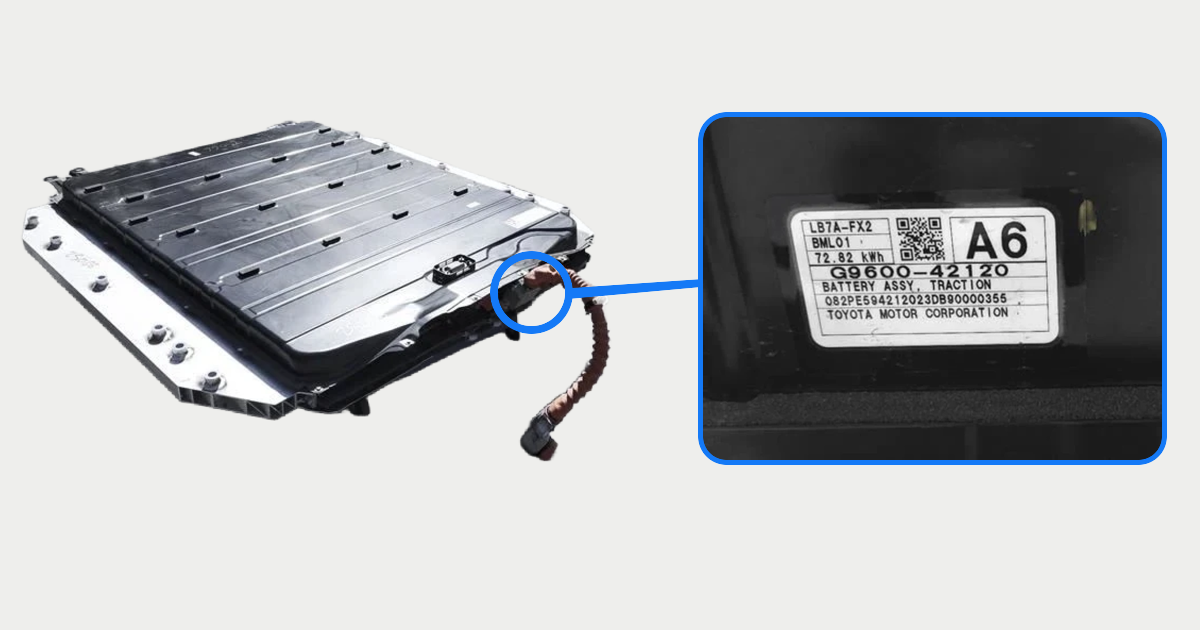
If a replacement battery has been installed, confirm the label and part number on the pack. The VIN describes the vehicle's build configuration, not every repair made later in its life.
Mustang Mach-E: One model name, two cathode families
The Ford Mustang Mach-E is a useful field example. Ford announced LFP as a second chemistry alongside nickel-cobalt-manganese, or NCM, and later made LFP standard on standard-range Mach-E models. Ford's 2026 Mustang Mach-E emergency response guide goes further. It maps the eighth VIN position to 73 kWh LFP standard-range configurations and 88 or 91 kWh NCM extended-range configurations.
For a 2026 Mach-E, the full VIN can resolve chemistry with strong OEM evidence. The words "Mustang Mach-E" cannot. Capacity can help narrow the candidates, but the supported configuration record is the better proof.
Do not carry that 2026 decoding table backward to every Mach-E ever built.
Earlier NMC pack family
The 75 kWh Explorer record shows the earlier nickel-manganese-cobalt pack family, including a real pack photo and 2021–2023 fitment.
Open the 75 kWh NMC record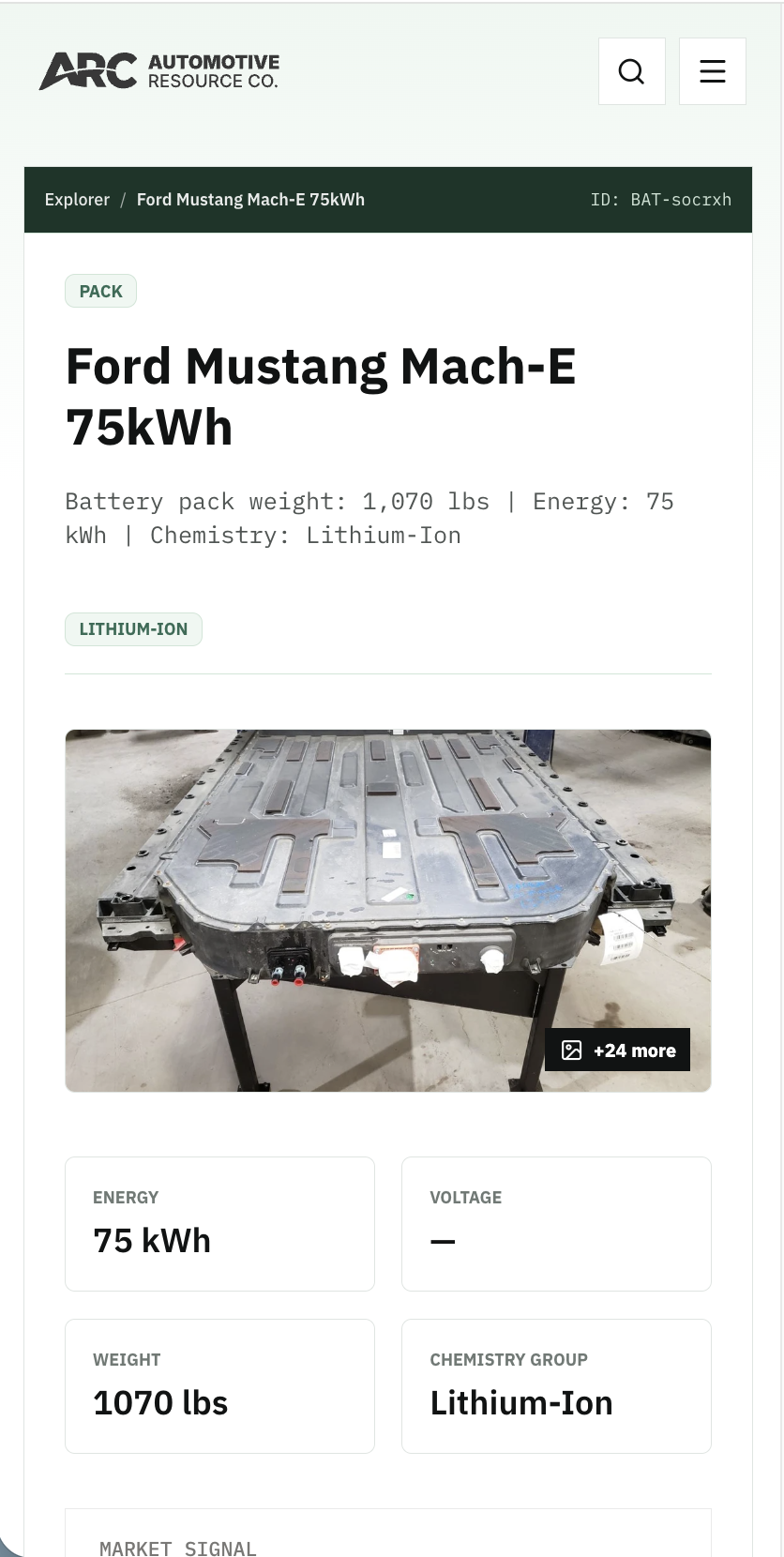
LFP pack family
The LFP Explorer record shows the iron-phosphate family used in later standard-range Mach-E configurations, with 2023–2026 fitment.
Open the LFP record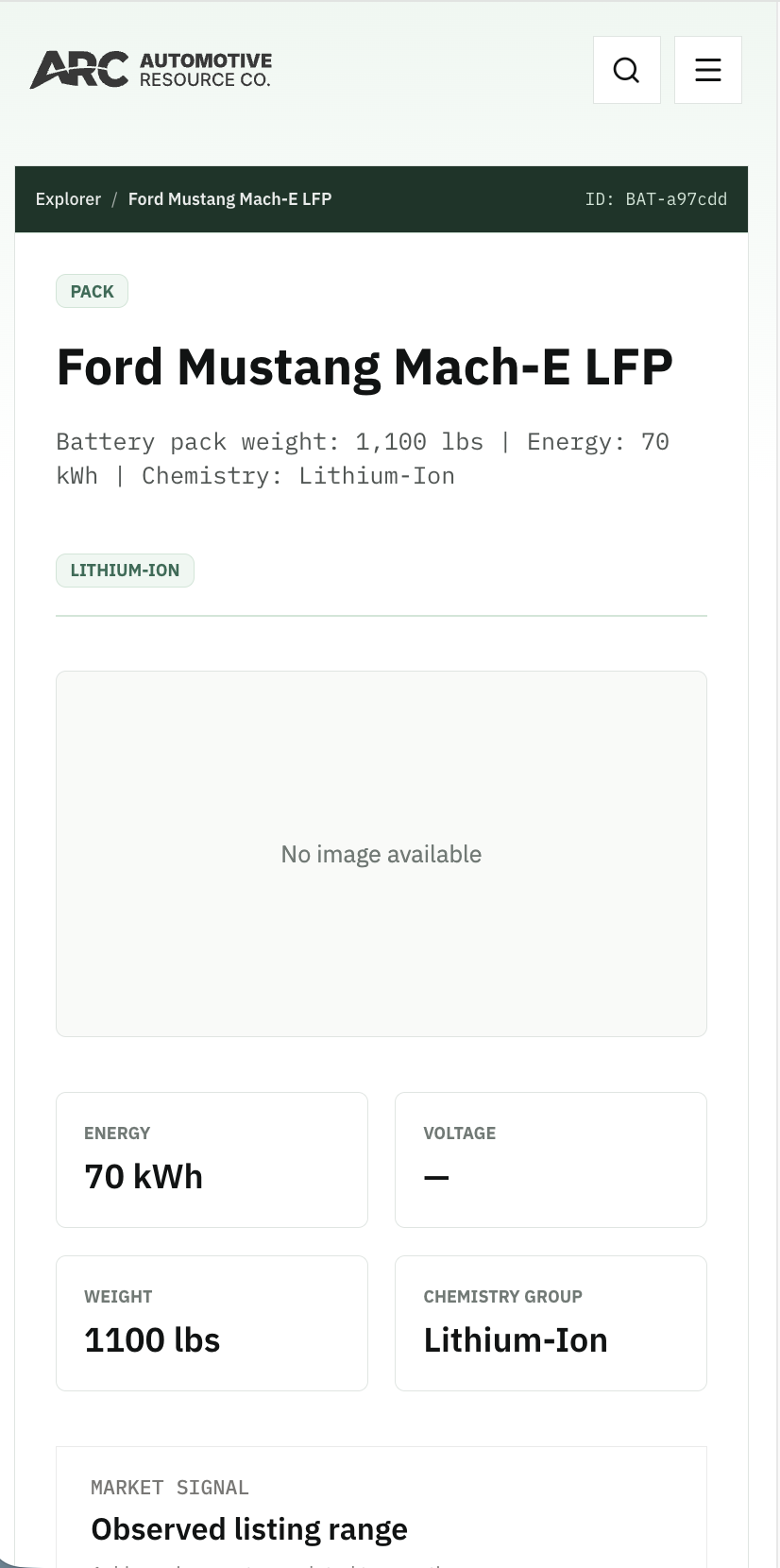
Chevrolet Volt: Cathode blends
The Chevrolet Volt shows a different identification problem. People often call the Volt battery "NMC." GM's own 2016 Volt battery specifications identify both the first- and second-generation packs as NMC-LMO pouch-cell systems. A California Air Resources Board technical assessment adds that the introductory Volt used an LMO-dominant NMC blend, while the second generation increased the NMC share and reduced LMO.
That difference is commercially important. If a buyer models the pack as pure NMC, the expected metal mix can be wrong before weight, condition, logistics, or processor terms are considered. It can also be wrong to apply one blend ratio to every Volt generation.
Record the supported blend and generation. Do not round a blended cathode into the simpler category because the simpler category is easier to price.
The fast way to identify chemistry: Use Explorer for free
You can do this research by hand. That means decoding the vehicle, finding the OEM build documents, checking every battery used by year and trim, sorting out engineering and service part numbers, finding pack images, and then preserving the sources behind the answer. It is possible. It is also a lot of work to repeat every time a battery shows up.
Explorer already does that work. The lookup is free.
- Enter the full VIN in Explorer. The full VIN gives Explorer the best chance to resolve the exact vehicle configuration.
- Open the battery result. Review the chemistry group, cathode chemistry, capacity, specifications, images, and source-backed fitment record in one place.
- Let Explorer narrow any remaining options. If the VIN leaves more than one factory pack, Explorer shows the likely candidates instead of making you research the whole model line.
- Check one physical clue when needed. Compare the label, part number, connector layout, cooling ports, or pack image Explorer shows you. ARC's EV battery identification guide explains what to photograph.
- Carry the result into the quote. Use the identified chemistry with the pack's condition, weight, location, and current buyer terms. The EV battery part-number guide can help when a service or interchange number needs another check.
Capacity can help separate two known options, but it is not a substitute for the battery record. When I am making a quote, I want the cathode chemistry recorded or clearly marked unresolved. "Probably NMC" is not the same answer as "NMC-LMO blend supported by the battery record."
Frequently asked questions
What is EV battery cathode chemistry?
EV battery cathode chemistry is the active-material family used on the positive electrode of the cell. In lithium-ion EV batteries, common cathodes include NMC, NCA, LFP, LMO, and blends. It is more specific than the broad lithium-ion chemistry group.
What do NMC 111, 622, and 811 mean?
They describe the approximate nickel, manganese, and cobalt proportions in the cathode's transition-metal mix. NMC 111 is roughly equal parts. NMC 622 is about 60% nickel, 20% manganese, and 20% cobalt. NMC 811 is about 80% nickel, 10% manganese, and 10% cobalt.
Can a VIN identify EV battery chemistry?
A full VIN gives Explorer the vehicle identity needed to connect it to ARC's battery and chemistry records. Explorer usually returns the battery configuration the vehicle was built with. When the VIN leaves more than one option, Explorer narrows the candidates and shows what to check on the physical pack.
Can I look up EV battery chemistry for free?
Yes. Enter the full VIN in Explorer for a free lookup. You can also search by year, make, model, or battery details when a VIN is not available, although a full VIN usually gives the most specific starting point.
Can the same EV model use different battery chemistries?
Yes. The Mustang Mach-E is one example. Ford documents LFP standard-range and NCM extended-range configurations for the 2026 model year. Always keep the model year, trim, drive type, and market attached to the chemistry result.
Is battery capacity enough to determine cathode chemistry?
No. Capacity can help distinguish known candidates, such as a standard- and extended-range pack. It is supporting evidence, not proof. Confirm the configuration and physical pack.
Does a replacement battery always match the original VIN record?
No. A vehicle may receive a later service revision, warranty pack, remanufactured pack, or other replacement. Confirm the current pack label and part number before relying on the original build record.
Does LFP always have negative recycling value?
No. LFP generally has lower intrinsic material value than nickel-bearing chemistries, which can make recycling economics harder. The actual quote can be positive, zero, or fee-based depending on condition, volume, location, freight, process, market terms, and other recoverable materials.
Put chemistry in the record before it reaches the quote
A useful battery record should answer two separate questions: What is the chemistry group? What cathode chemistry or blend does the evidence support?
You can build that record yourself from VIN rules, OEM documents, part numbers, labels, and pack images. Or you can use Explorer for free and start with the battery records ARC has already assembled. Review the Explorer-by-VIN API when the result needs to enter an intake, inventory, quoting, or routing system. For a mixed or high-value battery stream that needs a custom data workflow, talk with ARC about battery consulting.
Sources and methodology
This guide separates authoritative facts from ARC operating guidance. Cell anatomy, chemistry classes, vehicle configurations, and recycling-economics statements are linked to government, OEM, intergovernmental, and peer-reviewed sources. The identification and quoting workflow reflects ARC's operating practice. It is not a lab assay, appraisal, or shipping authorization.