How to Estimate EV Battery Scrap Value by VIN
How recyclers turn battery identity, chemistry, weight, pack construction, and logistics into a net quote.

An EV or hybrid battery headed to recycling is priced as feedstock. The VIN helps identify the source vehicle and the battery originally tied to it. The physical label, part number, and photos establish which pack is actually present.
Check the recycling estimate before you buy or sell a battery
Use Explorer first. Start with the VIN, confirm the installed pack, and review available chemistry and weight data before you price inventory, make an offer, schedule pickup, or choose a recycling route.
Know which battery price you are looking at
Search results and marketplace listings put several battery prices next to each other. Only two of them describe a recycling transaction.
| Value type | What it means | Main inputs | What the VIN contributes | What the VIN cannot prove |
|---|---|---|---|---|
| OEM replacement | The price of a new or service replacement through an OEM channel | Service part number, availability, warranty, labor, and supply | The vehicle and original battery or service family | The current OEM price or whether a revised or larger-kWh pack is installed |
| Used battery replacement | The price of a used pack or module set sold for continued vehicle service | Exact fitment, part number, state of health, test results, condition, demand, and warranty | The source vehicle and candidate fitment | The installed pack, its health, internal damage, or current demand |
| Recycling material estimate | The recycler's preliminary value for the confirmed chemistry and the gross, module, or cell weight it agrees to quote | Chemistry, weight type, pack construction, quantity, and the buyer's pricing rule | Candidate battery, chemistry, and weight records | The physical pack, final received weight on the recycler's scale, or current buyer price |
| Net recycler quote | What a specific buyer offers after its costs and terms are applied | Preliminary material estimate, preparation, packaging, freight, damage rules, fees, location, quantity, and timing | The source vehicle and candidate battery information carried into intake | Buyer acceptance or the final commercial offer |
Here, scrap value means the recycling material estimate or the net recycler quote. OEM and used battery replacement prices come from different buyers and different costs.
If a pack is being evaluated for continued use, run that evaluation separately. NREL's Battery Second-Use Repurposing Cost Calculator and its 2015 report on barriers to second use cover testing, refurbishment, controls, and application costs that do not belong in a recycling-material estimate. A 2026 Applied Energy paper provides a more recent comparison of second-life and recycling pathways.
How battery recyclers build a price
Battery recyclers buy feedstock for a recovery process. For a complete automotive pack, the confirmed chemistry and the gross, module, or cell weight the recycler agrees to price set the starting point. The offer then reflects the work and cost required to receive, prepare, and process that specific battery.
A lithium-ion recycler is after the critical minerals and other recoverable materials in the cells and pack. Chemistry tells the buyer what material mix to expect. The chosen weight type tells you which mass belongs in the preliminary calculation.
Working estimate
Preliminary material value = recycler's current chemistry price × gross, module, or cell weight used for the quote
Estimated net recycler quote = preliminary material value - preparation and disassembly - packaging and transport - other stated adjustments
Use this working model to prepare a recycler quote. It is not a published market rate or a substitute for the recycler's offer. A recycler may quote a complete pack by gross weight, by cell weight plus a pack-preparation charge, or by a known-pack unit rate. Ask which method the recycler uses before putting a rate into a spreadsheet.
For automotive batteries, the recycler weighs the delivered material on its own scale and pays from that received weight under the written terms. Payment is set after delivery. It is not calculated from the material that later comes out of the recycling process.
Chemistry tells the recycler what material stream to expect
Lithium-ion batteries use several cathode chemistries. NMC, NCA, and LFP contain different cathode materials. Nickel-metal hydride batteries follow another material and processing path. The EPA's lithium-ion battery recycling overview, updated in 2025, describes common cathode chemistries, pack components, and material streams created during recycling.
Once the chemistry is supported, the recycler can sort the pack and choose a pricing rule. Vehicle make alone is not enough because suppliers, cell designs, chemistries, and capacities can change across years, trims, plants, and service revisions.
Argonne National Laboratory's 2019 EverBatt model separates battery chemistry, material inputs, transportation, labor, and recycling process costs. That version models recycling at the cell level and excludes pack discharge and disassembly, so it does not supply a pack-preparation rate. A public commodity price still covers only one part of a recycler's calculation.
Gross pack weight versus cell weight
| Weight type | What it includes | How it is used | Main limitation |
|---|---|---|---|
| Gross pack weight | Cells, modules, enclosure, cooling system, cabling, electronics, covers, and other installed components | Receiving, freight, storage, and some pack-level pricing rules | Not all of that weight enters the same recoverable material stream |
| Cell or module weight | The cells or supported module assembly used for the quote | Pricing rules tied more closely to the material entering the recovery process | Often harder to verify without a reliable bill of materials or physical breakdown |
| Actual received weight | What arrives at the buyer, including missing or extra components | Final payment weight after delivery | May differ from a published specification or seller estimate; ask how pallets, packaging, and missing components are handled |
Record both gross pack weight and cell or module weight when reliable data exists. Freight still follows the complete shipment weight even when the material rate is based on cell weight.
Explorer recycling estimate
Check the battery's recycling estimate before you price inventory, make an offer, or schedule pickup. When ARC has the fields, Explorer can show gross pack weight and cell weight and use that data in the estimate. Start with the VIN and verify the result against the installed pack.
Get your recycling estimatePack construction affects preparation, disassembly, and freight
Cell format, module layout, enclosure design, cooling hardware, busbars, wiring, adhesives, and included electronics change the work between receiving a pack and feeding material into a process. Pouch, cylindrical, and prismatic cells may arrive in very different pack structures. Record what the evidence supports and let the recycler apply its own preparation rule.
Condition changes the work as well. A complete, dry pack with intact covers presents a different receiving job from one with collision damage, fire or water exposure, missing covers, cut high-voltage cables, or unknown electrical state. State of health can raise the price of a battery sold for continued vehicle service. Recyclers still need condition and electrical information because it affects safe handling, acceptance, packaging, and transport.
Battery recycling usually works better in bulk. Packaging and picking up one pack can consume most or all of its material value. A sorted group of identified packs spreads those costs across more weight and gives the recycler a clearer load to plan. Chemistry mix, damage, distance, loading access, and timing still affect the offer.
Why start with the VIN?
A VIN gives the recycler intake record a vehicle anchor. Use Explorer first to get a working recycling estimate before you price inventory or evaluate a purchase. Enter the VIN to identify the vehicle and review connected battery and cell records where available. Free accounts include one in-app VIN lookup each month.
Start with these questions:
- What is the vehicle electrification level: battery electric vehicle (BEV), plug-in hybrid electric vehicle (PHEV), hybrid electric vehicle (HEV), fuel cell electric vehicle (FCEV), or internal combustion engine (ICE)?
- What year, make, model, trim, drive configuration, and market does the record support?
- Which battery family, chemistry, gross weight, cell weight, and physical layout are plausible?
- Which labels, part numbers, connectors, and pack photos should match the installed battery?
The VIN lookup cannot see the battery installed in the vehicle today. Warranty, recall, and normal service work can install a revised part number or a larger-kWh pack. Collision repair, remanufacturing, and module work can change the assembly again. A loose pack may have no reliable vehicle history.
Confirm the battery with its physical labels, part numbers, connectors, and photos before using its chemistry or weight in a recycler estimate. ARC's Explorer-by-VIN API supports the same starting workflow inside intake, inventory, and quoting systems.
How to estimate EV battery scrap value by VIN
Use these eight steps when the intended outlet is a battery recycler. For a loose pack with no VIN, begin at step 2.
1. Decode the VIN in Explorer
Use the VIN to identify the source vehicle, electrification level, and candidate battery records. Save the lookup date and mark any unresolved fields.
Keep the VIN source with the intake record. A windshield plate or door-jamb photo is stronger evidence than a VIN copied through several seller documents. When the pack is loose and the VIN is gone, move to its label and physical features. ARC's battery identification guide covers that intake path.
Use Explorer first
Know the recycling estimate before the battery changes hands.
Explorer starts with the VIN and connects the vehicle to candidate battery and cell records. Use the available chemistry, gross pack weight, cell weight, enclosure details, part numbers, and reference photos to build a recycling estimate. Use it to price inventory, evaluate a purchase, schedule pickup, or choose a route.
Free accounts include one VIN lookup each month.
Get your recycling estimate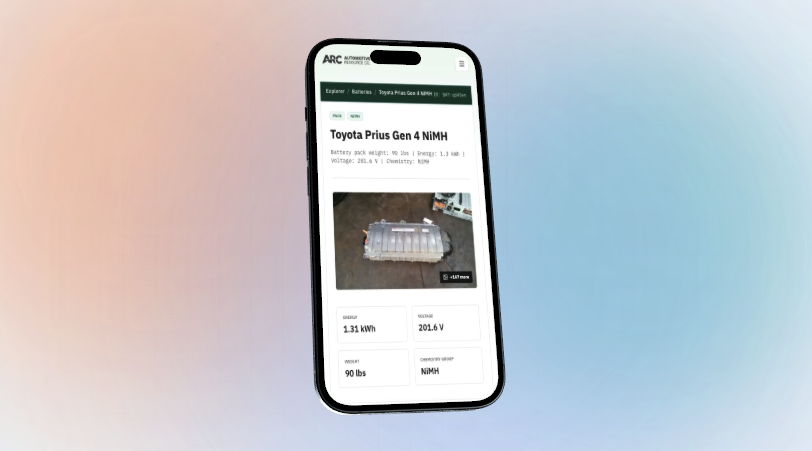
2. Confirm the physical pack
Match the candidate battery to labels, part numbers, full-pack photos, connectors, cooling ports, service disconnect, and visible construction.
Photograph the complete battery before relying on a label close-up. A remote reviewer should be able to see which pack the label came from and whether covers, connectors, modules, or other components are missing.
Give each identifier its own field:
- Engineering or assembly number
- Service or catalog part number
- Serial number
- Supplier, date, lot, barcode, or QR data
- Voltage and energy markings
- Chemistry or battery-type markings
- Recycler or inventory interchange number, if one exists
The number printed on the pack may differ from the current service number. ARC's guide to finding an EV battery pack part number explains how to reconcile label, service, supersession, and interchange evidence while preserving the original record.
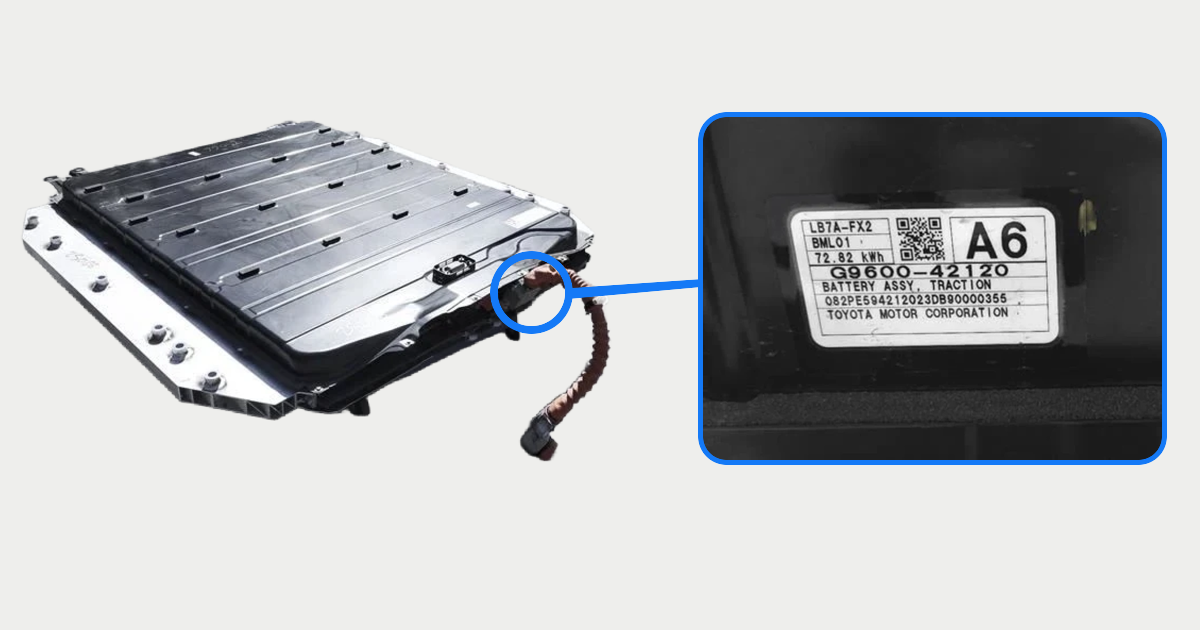
Real pack example
Match the exterior, part-number label, and connector layout
Explorer connects the vehicle record to a candidate battery. These three views help confirm whether the physical battery matches that record.
Exterior angle
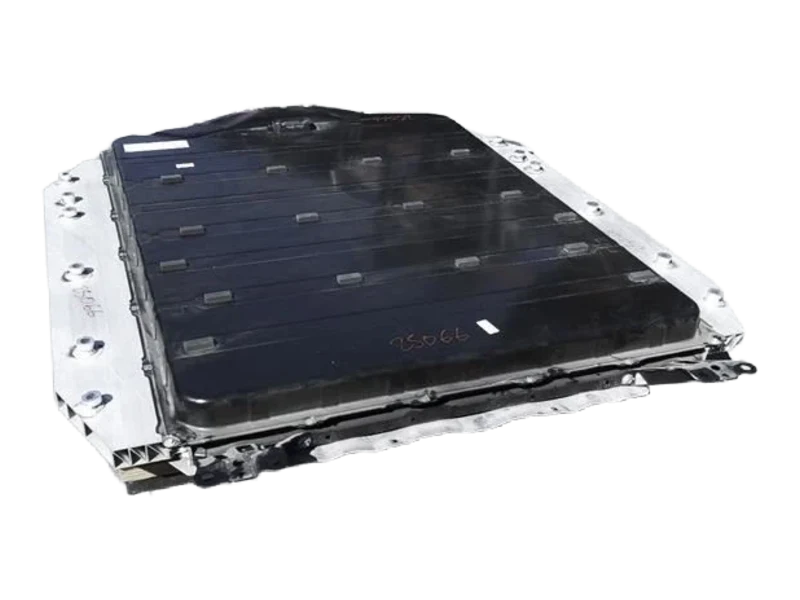
Use an exterior angle that shows the enclosure shape, mounting rails, cover, and whether components are missing.
Part-number label
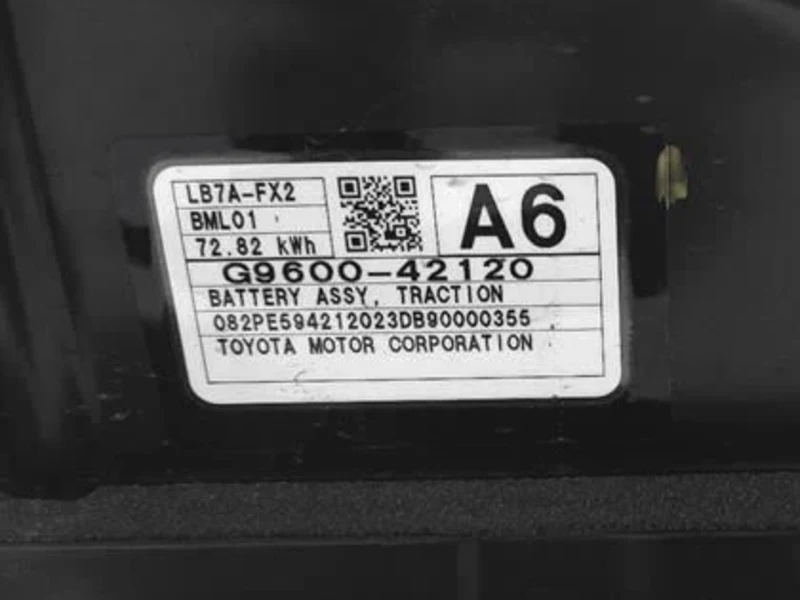
Read the assembly number, rated energy, serial data, and manufacturer. This label shows G9600-42120 and 72.82 kWh.
Connector layout
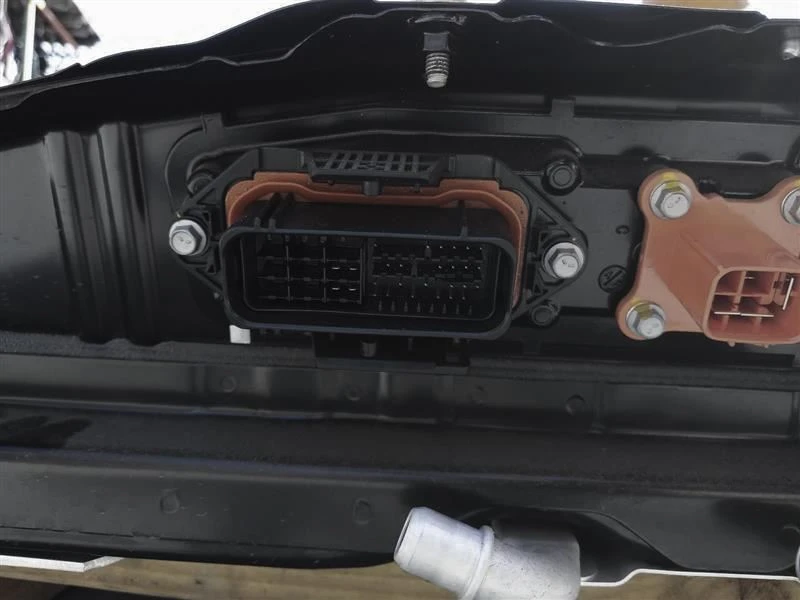
Compare housing shape, pin arrangement, seals, hardware, and visible condition with the reference record.
3. Establish the battery chemistry
Record the cathode chemistry or battery type confirmed by a label, cell record, or technical source. Save that source with the estimate. Do not infer chemistry from the vehicle make alone.
Start by separating lithium-ion from nickel-metal hydride. For lithium-ion packs, use NMC, NCA, LFP, or another chemistry only when a reliable pack, cell, supplier, or technical record supports it. Save the source and note whether the result applies to the complete pack, a module family, or a specific cell.
If the evidence supports only a broad battery type, leave the detailed cathode unresolved. The recycler can still decide whether to request more evidence, quote conservatively, or inspect the pack before giving a final quote.
4. Record gross pack and cell weight
Record the complete pack weight and, when available, the cell or module weight. Confirm whether the recycler quotes gross pack, cell, module, unit, or received weight.
For every weight, save the unit, source, and description of what is included. A catalog specification may describe a complete production pack. A scale ticket may describe an incomplete pack, a pack on a pallet, or a shipment with added bracing. Label those records clearly.
Do not use kWh as a substitute for weight. Two packs with similar energy capacity can have different cell chemistries, cell formats, enclosure mass, and cooling systems. If cell weight is unavailable, leave it unresolved and ask whether the recycler can quote on gross pack weight.
5. Document form factor and pack construction
Record the cell format, module layout, enclosure, cooling system, cabling, and included components that affect preparation and disassembly.
Useful fields include:
- Cylindrical, pouch, or prismatic cell format
- Module-based, blade-style, or cell-to-pack construction when supported
- Module and cell counts when supported
- Steel, aluminum, composite, or mixed enclosure information
- Liquid or air cooling hardware
- Busbars, harnesses, BMS hardware, contactors, service disconnects, and covers present
- Pack dimensions, pallet footprint, and lifting or loading requirements
The recycler may price the preparation work as a fixed pack charge, a deduction from the weight rate, or part of its internal margin. Do not estimate cell weight by subtracting a generic enclosure percentage. Use a reliable bill of materials, known cell count and cell mass, or the buyer's own receiving method.
6. Record condition, quantity, and location
Document damage, completeness, electrical state when known, quantity, storage location, loading access, packaging status, and pickup timing.
Record whether the battery is installed, removed, opened, or incomplete. Photograph dents, punctures, crushed areas, swelling, leaks, burn marks, water exposure, missing covers, cut cables, and removed modules. State whether the pack is known to be isolated or discharged, or whether its electrical state is unknown.
A state-of-health test is not required to estimate a pack as recycling feedstock. If SOH or diagnostic data already exists, keep it with the record, but do not turn it into a material premium unless the recycler's written terms say otherwise.
Also record how many packs are available, whether they are the same battery family and chemistry, where they are stored, whether a forklift or dock is available, and whether compliant packaging is already on site. A single battery may not justify a dedicated pickup. Tell the recycler whether more packs are expected and whether the load can be grouped and sorted by battery family or chemistry.
PHMSA's 2023 transport guidance states that damaged, defective, or recalled lithium batteries have greater fire risk and must meet applicable hazardous-material transport requirements. Do not move or ship a battery until a trained person has reviewed its condition and the applicable packaging, carrier, and transport rules.
7. Get the recycler's current terms
Ask which chemistries and conditions the recycler accepts, how the quote is calculated, which weight type it uses, its minimum pickup quantity, who pays freight, and when final payment is set.
Ask the buyer or processor:
- Which battery types and chemistries do you accept?
- Do you quote by gross pack weight, cell weight, module weight, unit, or another weight type?
- How do pack preparation and disassembly affect the rate?
- Are damaged, defective, recalled, opened, incomplete, or wet packs accepted?
- Who supplies compliant packaging and who pays freight?
- What is the minimum pickup quantity or shipment weight?
- Is pickup available, and how do quantity, chemistry mix, and location change the price?
- How should different chemistries or damaged packs be separated?
- What labels, photos, weights, dimensions, and electrical information are required?
- Are there sorting, discharge, handling, storage, processing, or rejection fees?
- Will final payment use the received weight on your scale?
Save the buyer, date, expiration, units, weight type, deductions, freight responsibility, receiving-scale terms, and payment timing with the estimate. A price copied from an old email is not a current term.
8. Check the rough net estimate
Subtract preparation, packaging, pickup, and other quoted costs from the recycler's preliminary price. If pack identity, weight type, condition, quantity, or freight is unresolved, keep the number as a range.
Keep the note next to the estimate simple. If one missing input can still move the number, name it. Final payment still uses the recycler's received-scale weight and written terms.
Two practical examples
These examples are hypothetical. They show the calculation without publishing a commodity rate, buyer payable, or dollar value.
Example 1: A known NMC load quoted on cell weight
A dismantler has six complete packs from the same battery family. Each pack has a donor VIN, a readable label, intact connectors, and no visible enclosure damage. Explorer links the vehicles to candidate battery and cell records. The labels and part numbers confirm the candidates, and the supporting records identify an NMC chemistry, gross pack weight, and cell weight.
The recycler's current rule uses cell weight and a fixed preparation charge per pack. The dismantler adds compliant packaging and one pickup for the grouped load. The packs have no state-of-health reports, which does not change their value as recycling feedstock. Their electrical state is recorded as unknown so the logistics team can review it.
Symbolic calculation: current cell-weight rate × total agreed cell weight - pack preparation - packaging - pickup = estimated net recycler quote
The dismantler now has a useful working estimate because the recycler confirmed acceptance, the weight type, the preparation charge, and the freight term in writing. Final payment will use the received weight recorded on the recycler's scale.
Example 2: The VIN points to the original pack, but the label shows a service replacement
A collision vehicle arrives with a VIN that points to the battery installed at the factory. The physical label shows a later OEM service part number, and the pack photos match a larger-kWh replacement used for that service campaign. The enclosure also has visible impact damage.
The operator uses the chemistry and weights tied to the installed service pack, not the original VIN candidate. The recycler reviews the damage photos before accepting the battery and provides separate packaging and freight requirements. Those costs are deducted from the preliminary material value for the replacement pack.
The VIN remains useful because it opened the vehicle record. The label and photos determine which battery enters the recycling estimate.
What a battery recycler needs before quoting
Send one complete intake record instead of a VIN in one message, a label photo in another, and shipping details later. The recycler can see what is known, what is supported, and what still needs review.
Real quote evidence
Show the recycler the complete pack, labels, connectors, and visible condition
A VIN or part number in a spreadsheet is not enough. Send photos that let the recycler compare the physical battery with the record and see what will arrive.
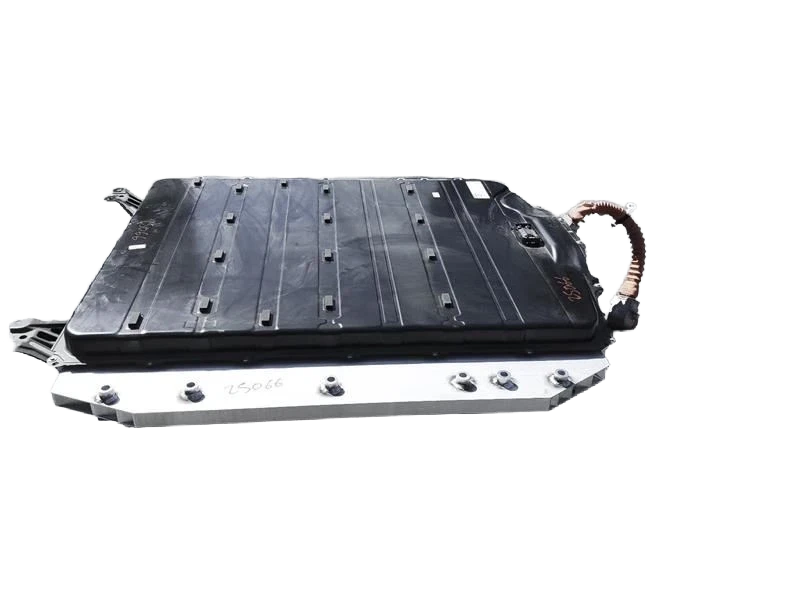
Full exterior: overall shape, included components, construction, and visible completeness.
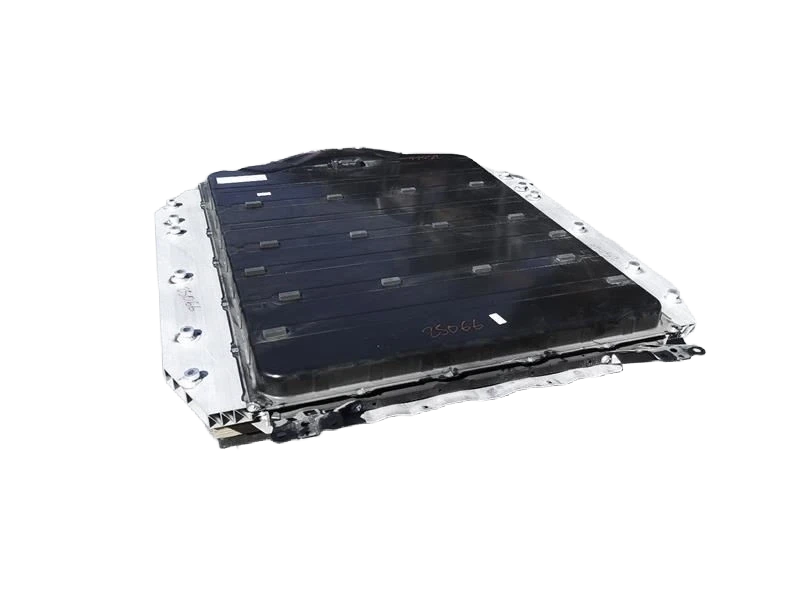
Additional exterior angle: condition evidence and areas hidden in the primary photo.
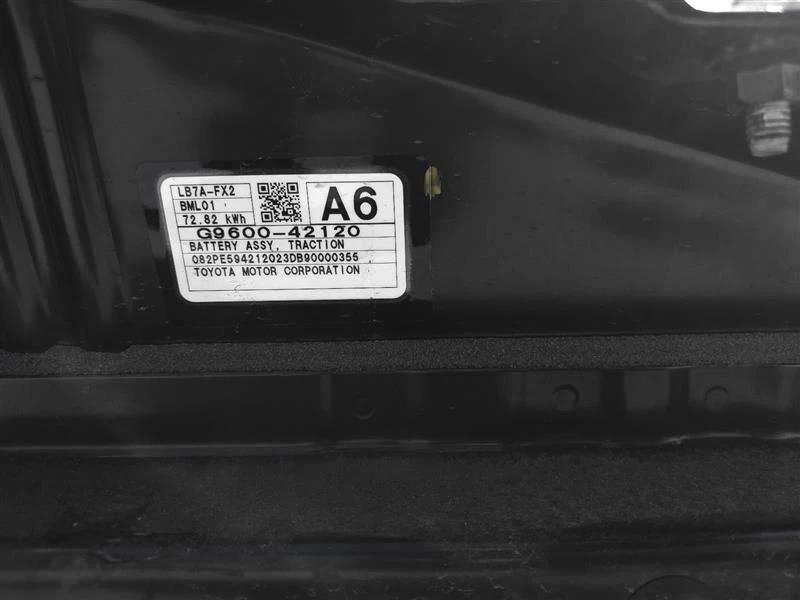
Assembly label: part number, rated energy, serial data, and manufacturer information.
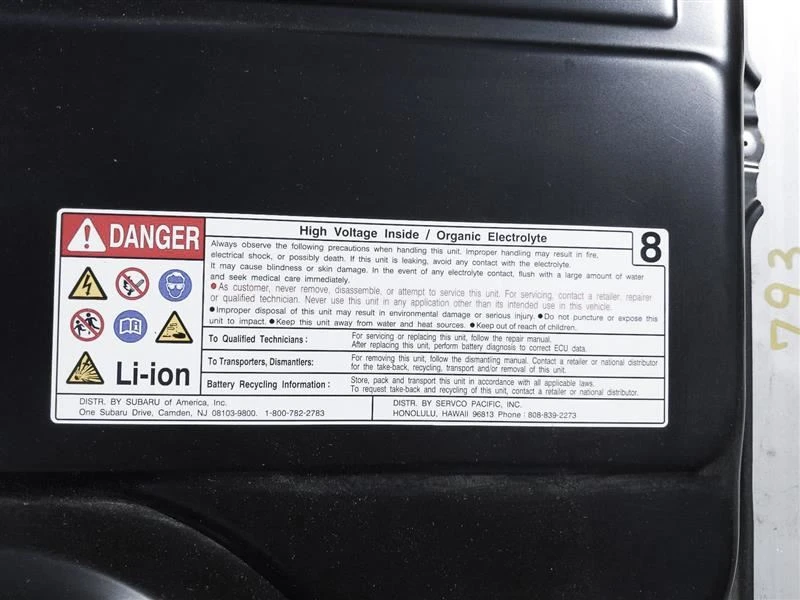
Battery-type label: broad chemistry family and high-voltage handling warnings.
Connector face: configuration, housing, fasteners, seals, and visible damage.
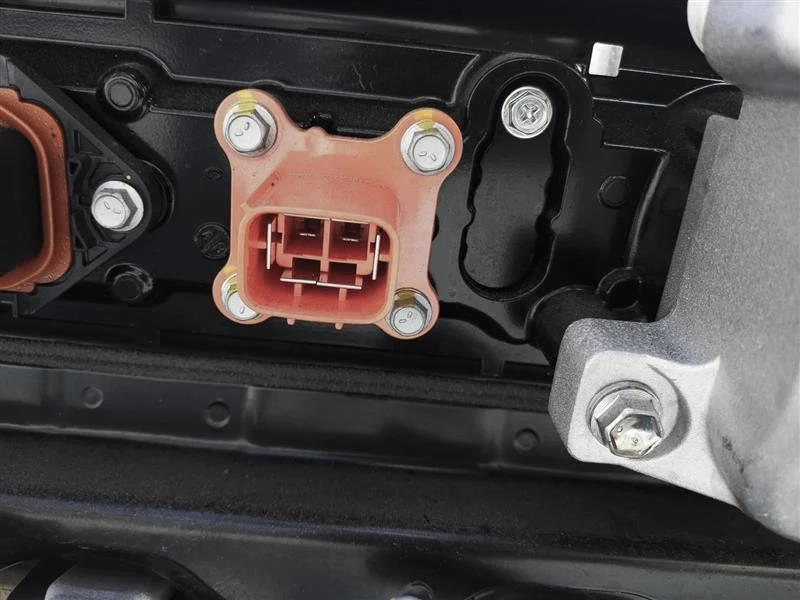
Connector detail: pins, seals, hardware, contamination, and handling damage.
Include:
- VIN or verified source vehicle, with a clear note when the VIN is unavailable
- Full battery label photo and transcribed label data
- Service, engineering, assembly, serial, and interchange numbers kept in separate fields
- Full-pack photos from all accessible sides
- Connector, cooling-port, service-disconnect, mounting-point, and enclosure photos
- Chemistry or battery type confirmed by a label, cell record, or technical source
- Gross pack weight plus cell or module weight when available, with units and sources
- Cell format, pack construction, module count, dimensions, and included components when supported
- Condition notes, including impact, water, fire, leaks, openings, missing components, and known or unknown electrical state
- Quantity, storage location, loading access, packaging status, and pickup timing
Ask the recycler to return the chemistry category, weight type, rate or unit method, pack adjustment, minimum pickup quantity, freight responsibility, other deductions, quote expiration, receiving-scale terms, and payment timing with the offer. Those fields make two quotes easier to compare.
If the battery is damaged or its electrical state is unknown, follow your trained site process and the applicable rules before anyone moves, tests, disassembles, or ships it. ARC's guide to handling EV and hybrid batteries is a practical starting point, and NHTSA publishes vehicle emergency response guides for trained responders. Site procedures and regulatory review still govern the work.
Common mistakes in EV battery scrap estimates
Quoting from the VIN without checking the pack
The installed battery may be a later service replacement with a different part number, capacity, chemistry, or weight. Read the physical label before applying a recycler rate.
Using an OEM or used-pack listing as the recycler number
OEM replacement and used battery replacement prices include fitment, supply, testing, warranty, and demand. A recycler's offer follows its preliminary material value, receiving costs, and current terms.
Pricing every lithium-ion battery the same way
NMC, NCA, LFP, and other lithium-ion chemistries present different material profiles. Apply only the chemistry category supported by the pack, cell, or technical record.
Applying a cell-weight rate to gross pack weight
Gross pack weight includes the enclosure, cooling system, cabling, controls, and covers. A cell-weight rate may exclude all of them. Use the weight type named in the buyer's terms.
Using kWh or SOH as a material multiplier
Energy capacity and state of health describe battery performance. They do not identify the chemistry mass that the recycler accepts for pricing.
Leaving construction, damage, and freight until the end
Pack dimensions, disassembly, compliant packaging, carrier acceptance, distance, loading access, and damage handling can consume the material credit. Collect those inputs before sending the quote.
Pricing one pack without checking pickup minimums
A single pack may cost more to package and move than its material credit can cover. Ask about pickup minimums, then look for a safe way to group identified batteries by chemistry and condition.
Reusing stale buyer terms
Rates, deductions, accepted chemistries, freight policies, and quote expirations change. Record the buyer and date on every estimate.
Reporting one exact number from unresolved inputs
Show a range when chemistry, weight, damage acceptance, quantity, or freight is unresolved, and name the missing input next to it. Replace the range when the recycler issues a firm quote.
Frequently asked questions
Can a VIN tell me the exact EV battery scrap value?
A VIN can identify the source vehicle and narrow the battery candidates. The quote still requires physical pack confirmation, chemistry, the gross, module, or cell weight the recycler agrees to price, condition, location, quantity, logistics, and current terms.
What do battery recyclers pay for?
A recycler estimates the value of the critical materials it expects to recover, then accounts for receiving and processing costs. Chemistry, weight type, pack construction, condition, quantity, freight, and current commercial terms shape the preliminary quote. Final payment uses the received battery shipment weight recorded on the recycler's scale after delivery.
Does state of health affect EV battery recycling value?
State of health can change the price of a battery sold for continued vehicle use, but recyclers are buying material feedstock. Damage, electrical state, and completeness still affect acceptance, preparation, packaging, transport, and processing costs.
Can I estimate EV battery scrap value from kWh alone?
Energy capacity does not identify the material mix or the mass a recycler will accept for pricing. Use kWh as a battery specification, then confirm chemistry, gross and cell weight, construction, condition, logistics, and current buyer terms.
Why does cell weight matter in a recycler quote?
Cell weight can be closer to the material-bearing feedstock entering a recycler's process than the weight of the complete enclosure, cooling system, cabling, and electronics. Some recyclers price gross pack weight instead, so confirm whether the buyer quotes gross pack, cell, module, unit, or received weight before applying any rate.
Can an OEM replacement battery differ from the original VIN record?
Yes. Warranty, recall, and normal service work can install a revised part number or a larger-kWh replacement pack. Use the VIN to find the original candidates, then use the installed pack's labels, part numbers, and photos for the recycling estimate.
What information do I need before requesting a recycler quote?
Send the VIN or source vehicle, full-pack and label photos, part numbers, chemistry confirmed by a reliable source, gross and cell weight when available, construction details, completeness, damage, quantity, location, packaging status, and loading access. Also tell the recycler what is unknown.
Is EV battery recycling more economical in bulk?
Usually. Packaging, pickup, paperwork, and handling can overwhelm the value of one battery. Grouping identified packs into a sorted load spreads those costs across more weight, although chemistry mix, damage, distance, and loading conditions still affect the quote.
Does a damaged EV battery still have recycling value?
It may. Damage can narrow the buyer list and increase preparation, packaging, transport, or processing costs. Get acceptance and shipping instructions from a qualified recycler or logistics provider before moving the battery.
Check the recycling estimate before you buy or sell the battery
Explorer starts with the VIN and shortens the research needed to price battery inventory or evaluate a purchase for recycling. Review the connected vehicle, battery, and cell records, then pull the confirmed chemistry, gross pack weight, cell weight, part numbers, specifications, and reference photos that are available. Check every field against the physical battery.
ARC supplies battery identification and research data. The recycler supplies the current pricing rule, weight type, preparation cost, logistics terms, receiving-scale record, and final payment.
Get your recycling estimate in Explorer. For a manifest or recurring intake, use the Explorer-by-VIN API to run the lookup inside your workflow.
Sources and methodology
ARC developed this workflow from its battery-identification expertise and industry experience. Commercial pricing, receiving-scale practices, and pickup economics vary by recycler and load. Public guidance and research from NHTSA, the U.S. EPA, PHMSA, NREL, Argonne National Laboratory, and the 2026 Applied Energy paper on second-life and recycling pathways support the technical, safety, and lifecycle portions. Recycler terms, battery markets, and transport requirements change. Confirm the current requirements and pricing before pricing inventory, making an offer, or moving a pack.