The U.S. Black Mass Export Ban, Explained
What Commerce's new rule does to whole EVs, intact packs, shredded battery scrap, and refined materials.

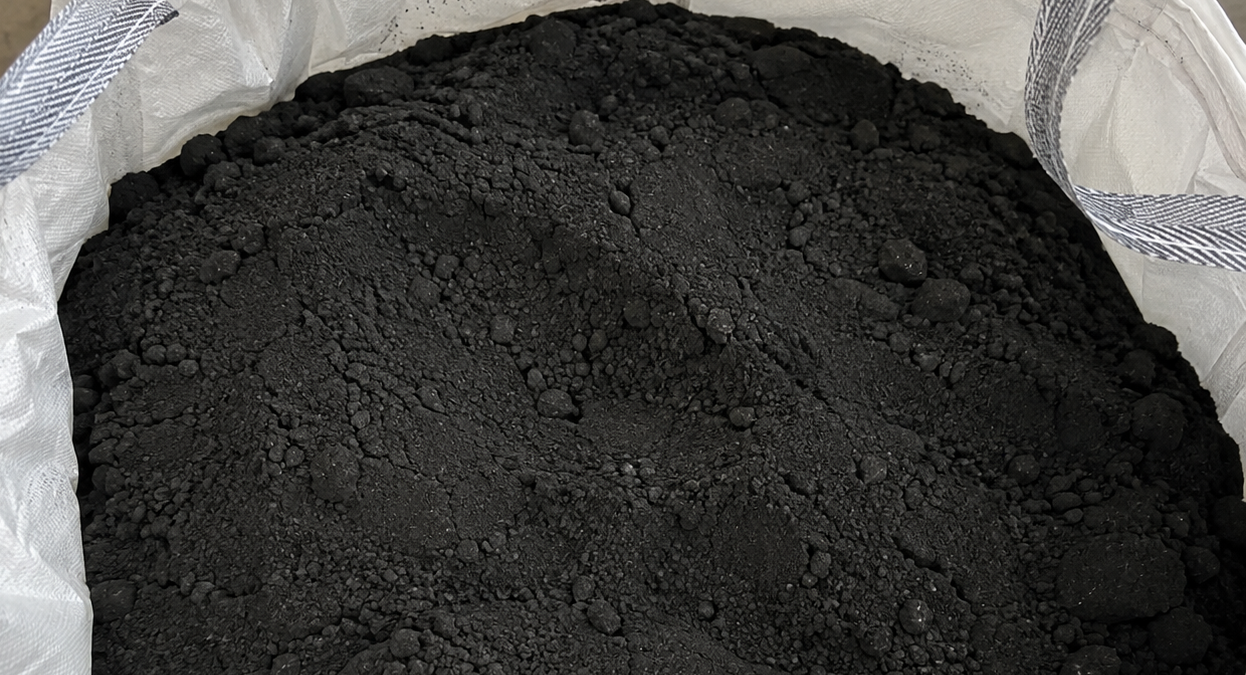
Under BIS's 2026 order, black mass is any shredded lithium-ion battery scrap that contains cathode material, anode material, or other residual battery-cell material. The order does not use age, end-of-life status, damage, or removal as the deciding condition.
In a temporary final rule scheduled for Federal Register publication on August 6, 2026, the Bureau of Industry and Security (BIS) requires U.S. persons selling covered black mass to direct 100% of their monthly sales to U.S. persons. The material must also stay physically in the United States unless BIS grants relief.
The order covers shredded battery material that contains residual lithium-ion material. That includes nickel-based and LFP black mass. It does not cover pure nickel-metal-hydride scrap. It also does not cover whole EVs exported with their batteries installed or intact EV packs sent abroad for recycling or second-life use. Distinct refined products, such as lithium carbonate or nickel sulfate, generally fall outside this order too.
The four stages that matter
The new rule covers black mass. To see where it applies, look at the stages a battery passes through from the vehicle to a recycled or refined battery product:
| Stage | Working reading | Reason |
|---|---|---|
| 1. Battery still in an end-of-life EV | Outside the black-mass definition | A complete vehicle is not shredded lithium-ion battery scrap. |
| 2. Battery removed but intact | Outside the black-mass definition | Removal, spent status, or damage is not the stated trigger. The pack, module, or cell has not been shredded. |
| 3. Battery shredded into electrode-bearing scrap | Covered | The material fits the definition when it contains cathode, anode, or other residual cell material. |
| 4. Scrap converted into a distinct refined product | Generally outside this order | A genuinely refined product is no longer obviously shredded battery scrap, although some intermediates remain uncertain. |
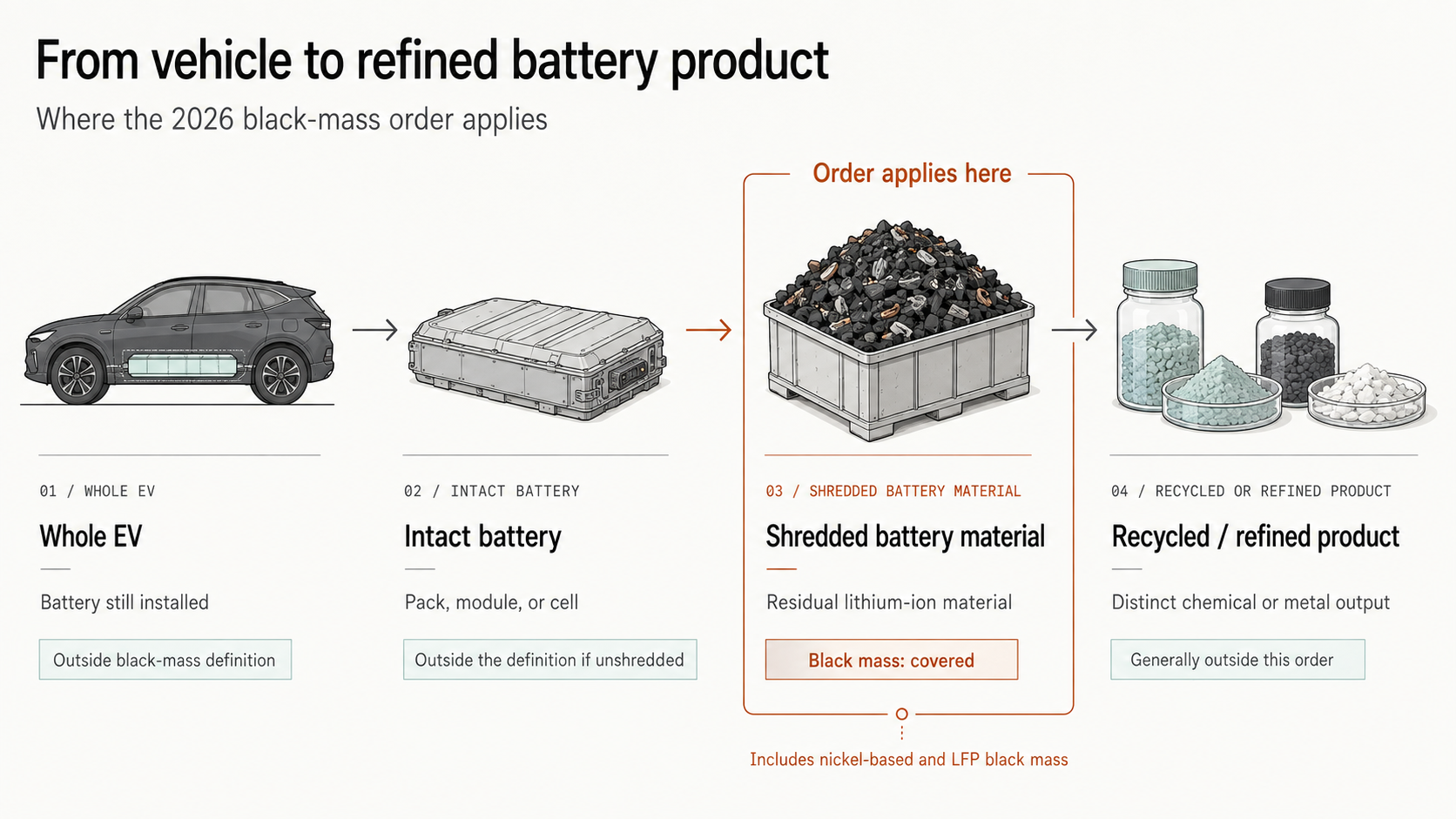
What does the rule call black mass?
For this order, black mass means any shredded lithium-ion battery scrap that contains cathode material, anode material, or other residual battery-cell materials.
The text gives examples on both sides of the cell. Cathode-related material may include aluminum, copper, iron, lithium, cobalt, nickel, and manganese. Anode material may include graphite and silicon.
The definition turns on one word: shredded. It does not say black mass must be a fine powder, uniform, dark, sale-ready, or already suitable for a hydrometallurgical process.
The first output may not look like the black powder people usually picture when they hear "black mass." A recycler might call an early output "intermediate shred" or "coarse shred." If the material is shredded lithium-ion scrap and still carries electrode or other cell residue, it may fit the definition before anyone produces a clean black powder.
The rule also gives no minimum concentration threshold. A clean copper, aluminum, or steel fraction with no cell residue is easier to separate from black mass. A fraction that still carries electrode coating or active material is harder to classify. The text does not say how much residue is enough, so process records and physical evidence may matter as much as an assay.
Whole EVs and intact batteries
End-of-life EVs are outside the black-mass definition
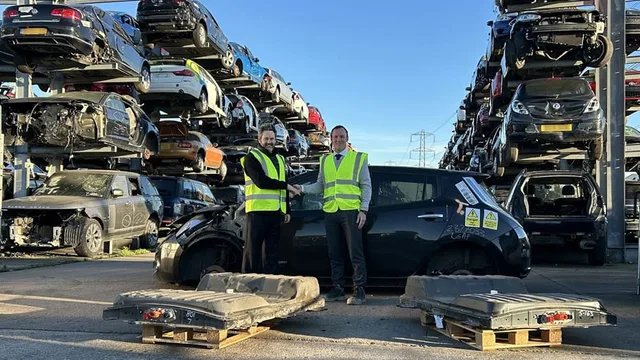
A complete EV with its battery installed is outside the black-mass definition as written. A whole-vehicle export is therefore not an export of black mass under this order, although customs, transportation, waste, and destination-country rules may still apply.
If the vehicle is crushed or processed so the shipment is no longer genuinely a vehicle, the analysis becomes fact-specific.
Removed but intact batteries are likely outside this order
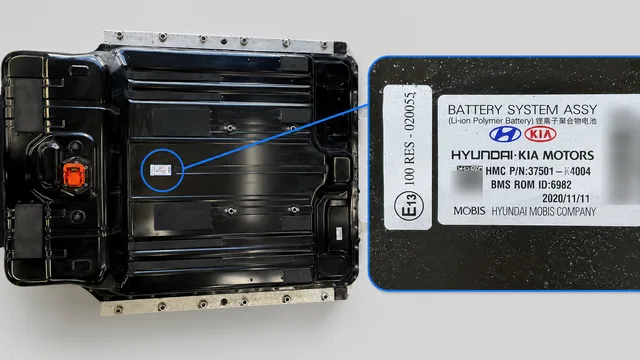
An intact pack, module, or cell that has been removed from a vehicle is likely not covered because it has not been shredded. That means a whole vehicle or intact battery pack may be exported outside the United States under this order, subject to other applicable requirements.
The challenge is shipping it. Damaged, spent, or nonfunctional packs can require separate packaging, hazardous-material transport, customs, carrier, waste, and destination-country compliance. ARC's practical guide to handling EV and hybrid batteries covers the safety and transport issues that remain even when a pack is outside the black-mass definition.
The order lists three battery-waste classifications: Schedule B codes 8549.13.00.00, 8549.14.00.00, and 8549.19.00.00. It then limits those classifications to material that also meets the black-mass definition. A battery-waste code by itself does not make intact material black mass.
For removed-battery shipments:
- A complete pack sent for reuse, remanufacturing, or second-life use remains outside the black-mass definition if it is intact.
- Intact modules and cells remain outside it, assuming they have not been shredded.
- Crushed or ruptured cells are harder to classify because the rule does not define "shredded."
- Mechanically granulated, milled, or shredded cells that retain electrode material are likely covered.
Before deciding whether an intact pack should be reused, shipped, or recycled, preserve the label and vehicle evidence. ARC's EV battery pack part-number lookup workflow helps reconcile the number on the pack with the VIN, catalog references, and photos.
For larger collection and handoff programs, containerized battery reverse logistics is the related operations question: how to identify, contain, document, and move batteries before they reach a recycler or processor.
For this order, the deciding facts are the battery's physical form and whether shredded scrap still contains lithium-ion cell material.
LFP black mass is covered. NiMH is not.
The definition is not limited to nickel- or cobalt-bearing chemistries. It expressly names iron and lithium among the possible cathode-related materials, and it does not require nickel or cobalt to be present.
Important: LFP black mass cannot be exported without prior BIS relief
LFP is a lithium-ion chemistry built around a lithium iron phosphate cathode. Because the order expressly includes iron and lithium among possible cathode-related materials, LFP black mass is covered once it meets the definition of shredded lithium-ion battery scrap. Covered LFP black mass must follow the same domestic-sales and physical-location requirements as other black mass.
NiMH battery scrap is not covered by this definition
A stream made up only of nickel-metal-hydride (NiMH), lead-acid, or sodium-ion batteries is not black mass under this order because the definition is limited to lithium-ion battery scrap. A mixed stream that includes lithium-ion material needs a closer review.
Chemistry identification example
Don't know whether your battery is nickel-metal-hydride or lithium-ion?
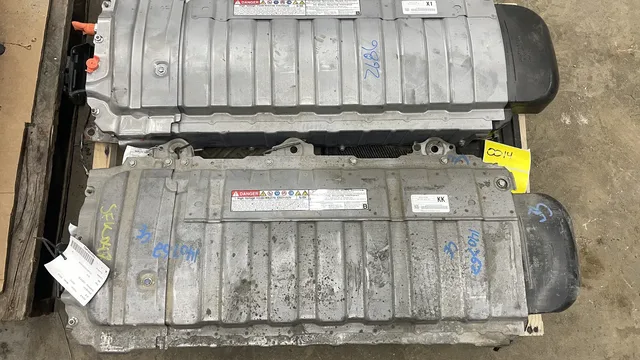
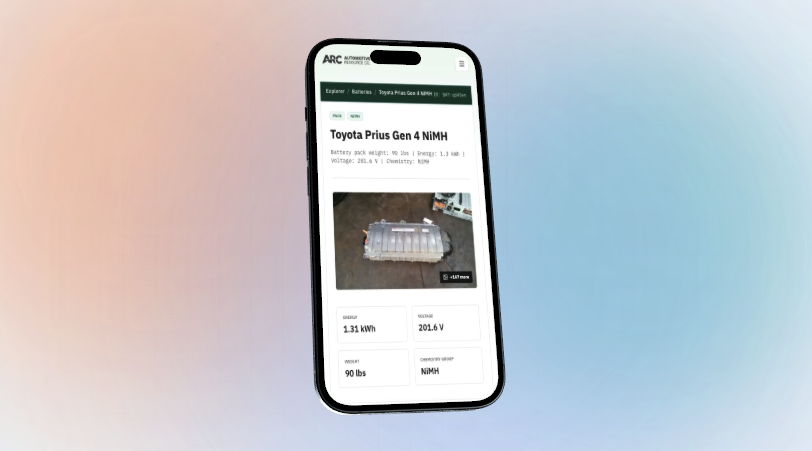
This pack is a Toyota Prius Gen 4 NiMH hybrid battery. Explorer connects the vehicle, label, photos, and battery record so a recycler can identify the chemistry before deciding how to route the pack.
Identify a battery in Explorer or see the identification workflow.
What is regulated once material becomes black mass?
All monthly sales must go to U.S. persons
Beginning 21 days after publication, U.S. persons that sell covered black mass must allocate 100% of their monthly sales to U.S. persons unless BIS grants an adjustment or exception in advance. The order applies to rated and unrated orders. It is not limited to government procurement or defense contractors.
This is not a government purchase obligation. BIS does not promise a buyer or set a price. The practical effect is that a company cannot use a foreign buyer for covered material without prior relief.
Who is a U.S. person?
For this order, a U.S. person is an individual or organization located in the United States. The definition focuses on location, so a U.S.-located subsidiary of a foreign company may qualify as a U.S. person. The material must still remain physically in the United States.
The material must stay in the United States
The buyer's identity is only part of the test. Covered black mass must remain physically located in the United States unless BIS authorizes otherwise.
For example, a recycler cannot assume that a sale to a U.S. broker solves the problem if the broker then exports the material. A domestic invoice does not make a later export permissible.
Internal and affiliate transfers count
The order defines "sale" broadly. It includes deliveries to affiliates and subsidiaries, along with transfers between branches, divisions, or sections under common ownership or control. A company cannot avoid the rule by keeping the same owner on both sides of the transaction.
What the order does not do
Put simply, the order controls where covered black mass can be sold and where it can be located. It is not, on its face, a ban on manufacturing black mass, owning it, selling it domestically, importing it, or refining it in the United States.
It also does not by itself cover whole EVs or intact battery packs. The restriction applies to covered black mass and tungsten waste and scrap. BIS says it may add other recoverable critical-mineral materials through a later Federal Register action.
When does black mass become a refined product?
The downstream boundary is less clear than the one at shredding.
The order identifies black mass through waste-and-scrap Schedule B codes and describes the material as shredded lithium-ion battery scrap. It does not list lithium chemicals, nickel or cobalt products, manganese products, graphite products, or recovered elemental metals as separate covered categories.
A product such as lithium carbonate, lithium hydroxide, nickel sulfate, cobalt sulfate, refined metal, or purified graphite may fall outside this order once the material has actually been converted into that product and receives a separate classification.
But not every process step creates a new product. The rule supplies no purity threshold, chemical-conversion test, or standard for partially upgraded black mass. Washing, drying, heating, screening, enriching, or renaming an intermediate may not be enough.
A clean, separately classified chemical or metal product is easier to treat as outside this order. Leached solids, mixed-metal concentrates, roasted material, and partially separated electrode fractions still need a careful classification decision.
Can black mass be exported for refining? Get BIS approval first.
BIS specifically lists a U.S. person's plan to send black mass abroad for processing or refining and then return the resulting material to the United States as a possible ground for an exception.
A company can ask for an exception for that arrangement, but BIS must approve it before the material leaves the country. Filing the request does not pause the domestic-sales requirement. The company needs a written interim authorization or final DPAS exception before export. BIS says it intends to respond within 14 days.
A DPAS authorization also does not replace a license or other authorization required under the Export Administration Regulations or another applicable regime.
How common transactions are treated under the text
| Transaction | Working reading |
|---|---|
| Totaled EV exported with its battery installed | Outside the black-mass definition if exported as a whole vehicle. Other rules may apply. |
| Intact removed pack exported for reuse or remanufacturing | Outside the definition if intact; this includes reuse, remanufacturing, and second-life shipments under this order. |
| Intact pack sent to a foreign battery recycler | Likely outside the black-mass definition if it remains intact. Other shipping, waste, customs, and export rules may still apply. |
| Modules shredded into a coarse mixture containing electrode material | Likely covered, even before a fine black powder is isolated. |
| Black mass sold to a U.S. broker that intends to export it | The domestic sale does not authorize the later export. The material must remain in the United States unless BIS authorizes otherwise. |
| Black mass delivered to a foreign affiliate for toll processing | Covered; the affiliate transfer does not create an exemption. Prior BIS relief is needed. |
| Domestic refinery converts black mass into a cleanly classified chemical product | Likely outside this order after genuine conversion, but the intermediate and classification record still matter. |
| LFP black mass | Covered. Export requires prior BIS authorization unless BIS grants an exception. |
Before you ship or recycle it, know what you have.
Start with a VIN, battery label, or photo in Explorer before routing the pack.
Start in ExplorerDates, exceptions, and enforcement
The public-inspection copy was filed August 4 and is scheduled for publication August 6, 2026. It still contains date placeholders. If the document publishes on that schedule without a change:
- August 27, 2026: the 100% domestic-sales requirement would begin, 21 days after publication.
- November 4, 2026: comments would be due, 90 days after publication.
- August 27, 2027: the temporary order would expire, 386 days after publication, unless BIS changes, extends, or replaces it.
BIS may grant company-specific or generally applicable relief for exceptional hardship, a result contrary to the purpose of the Defense Production Act, irreparable harm, additional compliance time, or foreign processing followed by the return of the resulting material. Requests go to DPASAllocations@bis.doc.gov.
CBP may detain covered material intended for export while BIS reviews the shipment. BIS may investigate, request information, seek an injunction, and pursue penalties. The agency may ask for buyer information, material descriptions, Schedule B classifications, quantity, and sale value.
Frequently asked questions
What is black mass under the 2026 Commerce order?
The order defines black mass as shredded lithium-ion battery scrap containing cathode material, anode material, or other residual battery-cell materials. The physical trigger is the combination of shredding and remaining cell material, not simply a battery's age or condition.
Does removing an EV battery make it black mass?
No. Removing a battery, taking it out of service, damaging it, or classifying it as waste does not by itself satisfy the definition. An intact pack, module, or cell remains outside the black-mass definition as written.
Does the order cover LFP black mass?
Yes. The order expressly includes iron and lithium among possible cathode-related materials and does not require nickel or cobalt. LFP black mass is covered once it meets the definition; exporting it requires prior BIS relief.
Can black mass be sent to a foreign refiner?
Not under the domestic-sales requirement without advance BIS authorization. Foreign processing followed by return of the refined material is listed as a possible ground for an exception, but filing a request does not suspend the restriction.
The bottom line
This order draws a line around black mass, not around every battery connected to an EV. Whole vehicles, intact packs, modules, and cells are outside the black-mass definition as written. Distinct refined battery materials are generally outside this particular order too.
Shredded lithium-ion battery scrap containing cathode, anode, or other residual cell material is the covered product. That includes LFP black mass, because the definition expressly includes iron and lithium. It does not include pure NiMH battery scrap, because NiMH is not lithium-ion.
Once material is black mass, U.S. persons must satisfy the domestic-sales and physical-location requirements. Exporting it—including for foreign refining and later re-import—requires prior BIS relief. Check the final printed rule and current BIS guidance before shipping.
Source note
This article interprets the public-inspection version of BIS's "DPAS Directive Allocation Order and Additional Requirements for Recoverable Critical Minerals and Materials", scheduled for publication August 6, 2026. It is an industry explainer, not transaction-specific legal advice. Confirm the final printed rule, current BIS guidance, customs classification, and any other applicable export, waste, and transportation requirements before acting.